What an interesting day.....
a nasty little weather system moved through and when it was gone we had snow half way down all the mountains, even the low ones!
Ventured over to Harrison Bay for a walk and first thing we noticed...
was this field was absolutely alive with....
American Robins! Had to be well over a hundred of them. Never have we seen that many robins this time of the year, in fact 'normally' we don't really expect to see any robins this time of the year and of course they are eating anything in sight.
there were also a few Varied Thrush mixed in which makes one wonder what the Varied Thrush will eat this winter with fruiting trees and shrubs pretty well picked over already.
there were also lots of smaller birds in the bushes, including several what appear to be young Gold-crowned Sparrow....
lots of Spotted Towhee....
and Song Sparrow....
also spotted this....
Yellow-rump Warbler.
We've seen a number of Northern Flicker every time we walk there lately, today this female posed for a few minutes on a fence post. Also saw a female Downy Woodpecker.
As for seasonal birds....they seemed to be rather lacking. Didn't see or even hear a single eagle.
there were a few Glaucous-wing Gulls, like this guy but not many, of course there are lots of boats running up and down the river right now so not likely to see many water birds while there is so much disturbance.
There was a Northern Harrier coursing over the fields and...
this young Red-tail Hawk was spotted trying to dry out.
Set out today, same time as yesterday.....
even more Canada Geese out there today....note the boat in the background....this one comes down the Harrison River from the lake for eagle viewing.
see those ripples in the far corner of the first bay? There were a pair of Salmon spawning there - first ones of the season....
this dead one was floating off of the log bay an also saw a few live ones swimming in the area so that is good news, they are starting to arrive.
there were several American Goldfinch in that shrub....didn't manage a picture, but there was also a....
male Hairy Woodpecker....(males have red on the back of the head, females don't)
just for fun zoomed in for a close up.
There were a couple of robins and this....
young White-crowned Sparrow in the same area.
A sure sign of fall....
is the Woolly Bear Caterpillar...Folklore says you can tell how hard a winter it will be by the width of the orange strip....probably as accurate as any other means of predicting weather!
My trusty everyday camera, the Canon Powershot finally died. Ended up replacing it with a Nikon Coolpix with 60 x optical zoom. Since it finally stopped raining, thought I'd give it a try today.
So here is the estuary...note the dark spot out there across the water....
and there it is...with a Great Blue Heron on it.
First bay....looked for Salmon, couldn't see any yet, but there are geese out there...probably about 200 of them...
Here are some of the Canada Geese...
Bald Eagle in one of the 'eagle' trees by the viewing platform.
no sign of salmon at the log bay yet either.
Happy to find a few King's Cup Gentian in flower in the grasslands. They'd been under water for so long I wasn't sure if they'd flower or not.
this evening spotted something out there in the water.....
turned out to be a young Hooded Merganser.
It is October and we are back home and ready for the action to start! One thing of note is....
how high the water levels are. I don't recall them ever being at this level at this time of the year...
we've often had water levels rise in late October or early November, from fall rains, but this year, thanks to a wet September, they've never dropped. The good news is that we won't need to worry if there is enough water for the salmon to make their way up....how or if it effects anything else, only time will tell.
another thing I've noticed, which I find a bit alarming, is that the native trees and shrubs, like this Black Hawthorne, as well as the Pacific Crabapples and even the Red-Osier Dogwoods have already been stripped of all their fruits or berries! That doesn't bode well as the fruits of these trees often last as a food supply well into winter. There must have been an amazing number of birds moving through in the past month to have cleaned out the supply. The bird, of course, is an American Robin.
the farm fields adjacent to the dike have just been cut which probably explains this young Red-tail Hawk.....keeping an eye out for any mice that might have been misplaced. The fields themselves were full of crows foraging for what ever they could find.
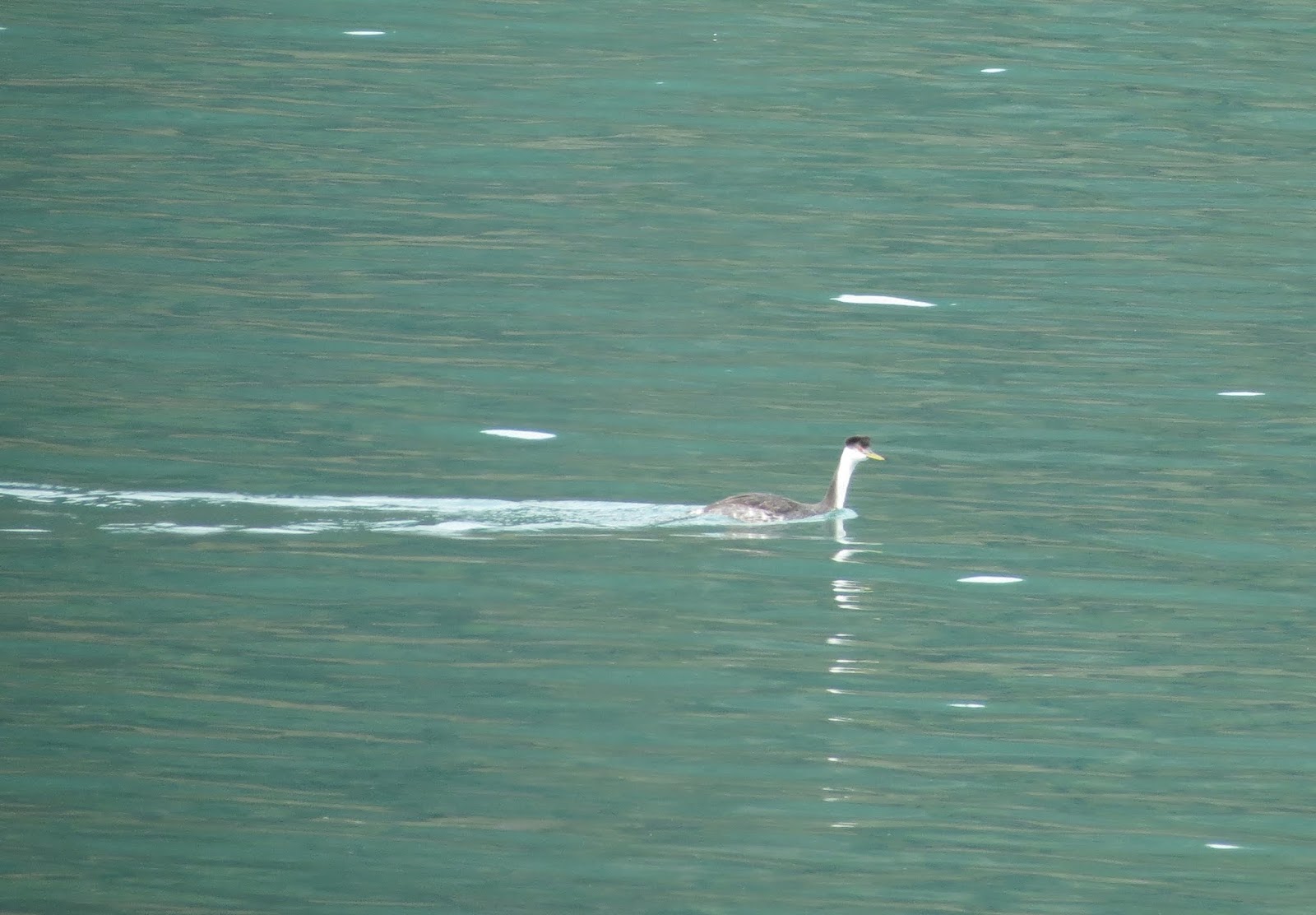
Out on the river....
we spotted this Western Grebe! Not the first time we've seen one here, but certainly not a species we can expect to see on a regular basis.
Eagles are in short supply at the moment, with only a couple being seen. Nothing in the way of ducks yet, swans are probably a month away .....
There are Canada Geese hanging about up in the estuary area.
In the riparian habitat the usual species, Black Capped Chickadees, Song Sparrows, Dark eyed Junco, Spotted Towhee etc. are being seen. Steller's Jay, Northern Flicker as well.
Home again for a little while so got for a walk over to the park today. The path across the grasslands is still under water although more and more of the grasslands are being exposed. It is the time of year when things tend to be very quiet.
This was the view from the viewing platform. Nothing moving. Purple Martins are gone, just a few Barn Swallows still around.
Vegetation getting very ratty looking - rose hips are ripening, some leaves are starting to fall...the good thing about this time of year is that you know it means fall and winter are on their way - because of course, it is fall and winter when this area comes into it's own.
The log bay is still a bay.....
but they have actually had to move the bench back to right beside the path because the bank has become so eroded.
looking down the other way....
there was a family of American Goldfinch at the log bay - this being the male, back into his sort of smudged looking plumage.
and I did spot this....
fledgling Flycatcher....not sure what type, usually either a Pacific slope or an Alder in this area. There was also a male Black-headed Grosbeak feeding a youngster, seems a bit late, but then I've noticed this year that there seem to be a few late families....for interest thought I'd post a few photos from our last trip away....all taken at Tunkwa Lake P. P.
American Crows usually nest quite early but this family had a couple of noisy youngsters still begging to be fed.
there was a family of House Wren as well...
Young Cedar Waxwing eating a Saskatoon Berry
Chipping Sparrow fledgling still being fed....
and then there were the baby ducks....Lesser Scaups....hard to believe these little guys will be ready to leave before the lake starts to freeze but obviously they will because they are always there in mid August while other species young are already just about grown.
and one last photo...Turkey Vultures....this is an evening roosting area - counted 27 that evening.
Not sure if I'll have another posting before we head to the island for a month or so. If not, well, we should be arriving home about the same time as the Salmon and eagles start to arrive....well hopefully salmon will arrive!
Here we are, the 4th of August already and there just hasn't been much of anything to post about. Haven't been able to get out on the water for a variety of reasons, seems when it is cool enough (not that it has been extremely hot, but none the less, sunshine on a gravel dike tends to get a bit toasty - especially for little black dogs) to actually go for a walk over at Harrison Bay, it is so windy there isn't much to be seen.
However, yesterday brought something interesting enough to warrant doing a posting. A friend was out in her kayak and spotted this.....
in the water. It was a solid jelly like glob not quite as big as a football, but getting there. Not knowing what it was, they maneuvered it out of the water and brought it home in a bucket of water....figuring I might know what it was. I didn't and neither did any number of neighbours who spend a lot of time 'out there' on the water and had never seen anything like it, but with a bit of searching on line it has been identified (and returned to the estuary). It is a Bryozoa, also commonly known as 'moss animal',
which turns out is an aquatic invertebrate, very tiny (less than .5mm) that lives in a colony, is a filter feeder and completely harmless although apparently they can sometimes clog pipes and things. There are 5000 species world wide, most in salt water, but some, like this one, in fresh. They have been around for 450 million years according to what I read, like shallow, warm water and reach maximum size in late summer/early fall and appear to be a recent addition to our area as one online report was about the first one ever found in Stanley Park and the date was 2017 - just 2 years ago! Guess yet another example of global warming at work.
So after that bit of excitement might as well mention the few things I have noticed the past little while....
there is Harrison Bay....your can't see the white caps out there, but trust me,, they are there....one day there were even rollers....it looked like the ocean! The beach is reappearing. Osprey nest is now vacated and judging from the number of Osprey flying about, seemed to have been successful. Noticed a flock of 12 California Gulls flying down the river the other day too - migration is now underway.
lot's of Cedar Waxwing around like this one enjoying the ripening Himalayan Blackberries. Haven't seen a young one yet but only a matter of time. Can't seem to venture outside without hearing waxwings.
most Swallows have raised their young now although there was a late family of Tree Swallows the other day, these being two of the four youngsters and Barn Swallows are still feeding young in nests.
I think most of the Bullock's Orioles have begun heading south, not hearing them as much as we were, but this youngster was over at Harrison Bay a couple of days ago.
here at the estuary, water levels are dropping rapidly - this photo was taken 3 evenings ago, water is much lower now, in fact given the warm temperatures forecast for this coming week, I expect we will be able to stand on the grasslands at the viewing tent site by mid week.
Birds are enjoying the shallow water and the muck it leaves behind....caught this Swainson's Thrush having a drink the other evening...
Frequently see the Eurasian Collared Doves either bathing or drinking...
and of course American robins seem to love this sort of stuff.
in our yard and pretty much everywhere else, lots of Black-capped Chickadee families. One day this past week we had a Red-breasted Nuthatch in the yard....first one in years....was just here for one afternoon and haven't seen it again.
Since we haven't got out on the water, haven't got a definite update on the Purple Martins but I know there has been a lot of over head activity although it is quieting down so my guess is they had another good year and migration will have begun for them. I have no idea if the new colony off of Kilby beach got used this year.
Hummingbirds, well the male Rufous are long gone, seeing a lot of Hummingbird activity though as the youngsters join the females and the Anna's are taking over again, they seem to lay low while the Rufous are here.
With water levels dropping rapidly and migration underway, who knows, maybe a shorebird will show up one day....it is the time of year when you never know what you might see where or when, so reminder to self - always have your camera with you!